On Writing, Uncertainty and The Drake magazine
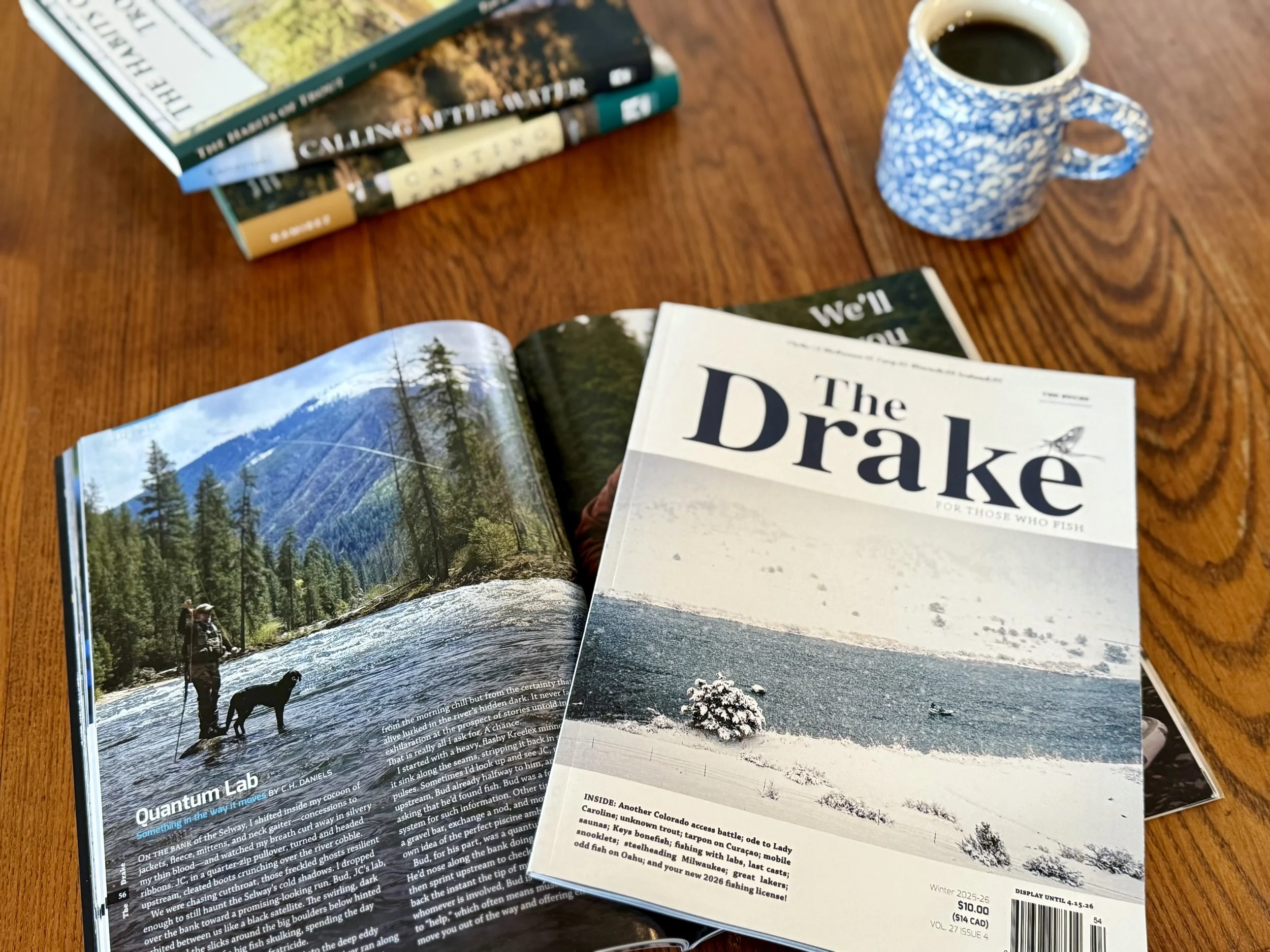
For most of my life, writing was something I did quietly. Journals, letters, essays — usually for myself, sometimes for a very small audience. Fishing came first. I was far more likely, as a kid, to skip school in favor of a river than to attend English class. My teachers would probably be surprised to know how much time I now spend with the written word.
For years, writing lived on the margins of my days. It was private, unhurried, and mostly unconcerned with publication. That changed when another writer I respect encouraged me to polish some of that work and send it out. It was a simple suggestion, but a meaningful one. Early drafts were rough — some painfully so — but there were a few early successes for which I remain deeply grateful.
Rejection, it turns out, is not the hardest part. Silence is. Not knowing whether a piece ever reached the right eyes, or whether it simply disappeared into the void, tests patience in a way outright rejection does not. Still, I kept sending work, trying to hone each piece and make it a little cleaner, a little sharper, a little better.
Long before I ever submitted anything, I was reading fly-fishing writers who shaped how I thought about both fishing and prose: Harry Middleton, John Gierach, Norman Maclean, Thomas McGuane. Submitting to a publication like The Drake always felt aspirational. I appreciated The Drake — not because of polish or prestige, but because it took fly fishing seriously as culture and literature, while never taking itself too seriously. Funky, irreverent, sometimes self-deprecating, and always willing to look sideways at our shared obsession.
But that isn’t why it felt aspirational. It was aspirational because so many contemporary writers I admire have appeared in its pages. These were men and women who were writers. So when my essay “Quantum Lab – Something in the Way It Moves” was accepted for the Winter 2025–26 Issue, I felt a sense that the long, private work had been seen.
It was only after seeing the Winter Issue in print that I realized Thomas McGuane and John Gierach also appear in the same issue, with Gierach’s essay published posthumously. That knowledge deepened the moment — not as validation, but as placement — my work briefly sharing space with voices that had long shaped how I read and wrote.
The essay, Quantum Lab, centers on a river in the Selway–Bitterroot wilderness, a good friend, and a black Labrador Retriever—the “Quantum Lab” everywhere at once. It’s about the intrigue in the shadows and about how the river does not always offer what you expect. As I wrote there:
“Perched at the river’s edge, peering into the deep eddy where the water turns slow and shadowed, a shiver ran along my arms, raising goose pimples beneath my sleeves—not from the morning chill but from the certainty that something alive lurked in the river’s hidden dark…That is really all I ask for. A chance.”
That line still feels true. A chance to fish. A chance to write. A chance to commune with uncertainty long enough for something meaningful to surface.
— C. H. Daniels